News Summary
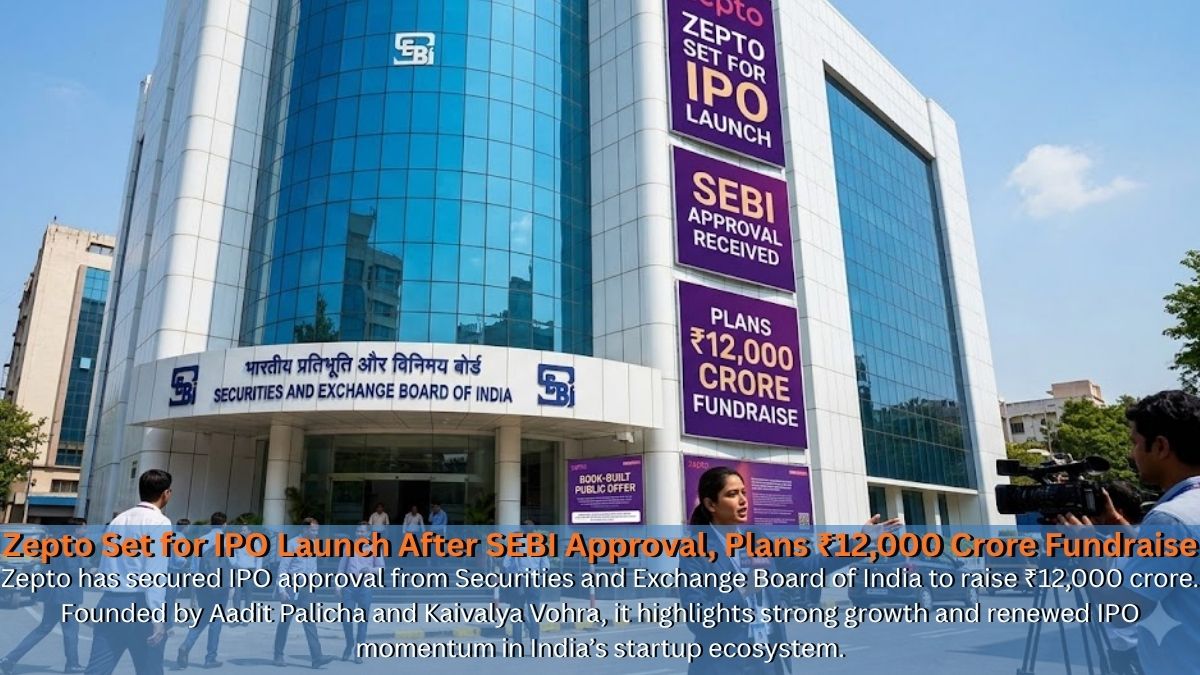
Zepto is now preparing for a major milestone as it moves closer to becoming a publicly listed company. The Mumbai-based quick commerce startup has received approval from the Securities and Exchange Board of India (SEBI) to launch its much-anticipated Initial Public Offering (IPO). This development marks a significant moment not only for Zepto but also for India’s rapidly evolving startup ecosystem. The company is expected to raise nearly ₹12,000 crore (approximately $1.3 billion) through the IPO. Reports indicate that the offering will include both fresh equity issuance and an offer-for-sale (OFS) component. This move will allow existing investors to partially exit while enabling Zepto to strengthen its balance sheet and expand operations.
Founded in 2021 by Aadit Palicha and Kaivalya Vohra
Founded in 2021 by Aadit Palicha and Kaivalya Vohra, Zepto has quickly emerged as one of the fastest-growing startups in India’s quick commerce segment. Known for its 10-minute delivery promise, the company has disrupted traditional grocery retail and e-commerce by focusing on speed, convenience, and hyperlocal logistics. The IPO comes at a time when investor interest in venture-backed startups is rebounding after a cautious period. Zepto’s strong growth trajectory, aggressive expansion, and improving unit economics have made it an attractive candidate for public markets. The company operates in a highly competitive space, alongside players like Blinkit, Swiggy Instamart, and BigBasket.
Moreover, the IPO signals a broader revival in India’s startup IPO pipeline. After a slowdown in tech listings, companies are once again looking to tap public markets for growth capital. Zepto’s listing could set the tone for other emerging startups planning IPOs in the coming months. With fresh capital, Zepto aims to expand its dark store network, invest in technology, strengthen supply chains, and improve profitability. As the company prepares for listing, all eyes are now on how it performs in the public market and whether it can justify its valuation.
1. Zepto Set for IPO Launch: A New Chapter Begins
1.1 IPO Approval and Fundraising Plan
The moment around Zepto Set for IPO Launch feels bigger than just another startup milestone. Zepto has officially received approval from the Securities and Exchange Board of India (SEBI), clearing a major hurdle on its path to the public markets. For any startup, this stage is not just procedural. It is emotional. It signals that the company is ready to move from private ambition to public scrutiny.
Zepto is planning to raise close to ₹12,000 crore through this IPO. That is not a small number. It reflects years of aggressive growth, heavy investment, and belief in the quick commerce model. The offering is expected to include both fresh shares and an offer-for-sale. This means early investors will get a chance to exit partially, while the company brings in fresh capital to strengthen its next phase. It is a delicate balance between rewarding early believers and preparing for future expansion.
1.2 Why This IPO Matters
The Zepto Set for IPO Launch is not happening in isolation. It comes at a time when the startup ecosystem is trying to find its rhythm again after a cautious phase. Over the past few years, IPO activity slowed down, and investor sentiment became more selective. Companies were no longer rewarded just for growth. Profitability and sustainability started to matter more.
That is why Zepto’s IPO carries weight. It represents a shift. It shows that high-growth startups can still attract public market interest if they demonstrate discipline and improving economics. More importantly, it could act as a signal for other unicorn startups waiting on the sidelines. If Zepto performs well, it may open the door for a new wave of IPOs. In many ways, this is not just about one company going public. It is about restoring confidence in the broader startup market.
2. Zepto’s Journey: From Idea to Unicorn Startup
2.1 Founders and Early Days
Every startup story begins with a simple question. For Zepto, that question was almost personal. Why should grocery delivery take hours when people need things instantly? Aadit Palicha and Kaivalya Vohra were young, ambitious, and willing to take risks. They dropped out of Stanford University to chase an idea that many initially doubted.
At that time, the market was already crowded with e-commerce players promising same-day or next-day delivery. But the founders saw something others missed. Urban consumers were not just looking for convenience. They were looking for immediacy. That small insight changed everything. It led to a model where speed became the core product, not just a feature. Building that vision was not easy. It required rethinking logistics, supply chains, and customer expectations from the ground up.
2.2 Rapid Growth and Expansion
What followed was a phase of intense growth. Zepto expanded quickly across metro cities like Mumbai, Bengaluru, and Delhi. The promise of 10-minute delivery felt almost unbelievable at first. But once users experienced it, it became addictive. Convenience turned into habit, and habit turned into demand.
Behind the scenes, this growth came with immense pressure. Scaling operations at such speed is not just about opening new locations. It involves building dark stores, managing inventory, hiring delivery partners, and ensuring consistency. One delay can break the entire promise. Yet, Zepto managed to execute with remarkable speed. In a short span, it entered the unicorn club. But more importantly, it became a part of everyday life for many urban consumers.
3. Business Model: How Zepto Works
3.1 Quick Commerce Explained
Zepto operates in what is now known as quick commerce. On the surface, it looks like a simple upgrade to e-commerce. But in reality, it is a completely different system. Traditional e-commerce focuses on scale and variety. Quick commerce focuses on speed and proximity.
Zepto achieves this through a network of dark stores. These are small warehouses located close to residential areas. When a customer places an order, the system identifies the nearest store, processes the order instantly, and dispatches it within minutes. The entire process is designed to minimize time at every step. From picking items to handing them over to delivery partners, every second matters. This is not just logistics. It is precision at scale.
3.2 Revenue Model
Behind the convenience lies a carefully structured revenue model. Zepto earns margins on the products it sells, sourcing them directly from brands and suppliers. This allows better control over pricing and inventory. In addition, delivery fees contribute to revenue, especially during peak demand.
Another growing stream is advertising. Brands pay to be featured prominently on the platform, gaining visibility among active users. This creates a new layer of monetization without increasing costs significantly. The company is also exploring private labels, which can improve margins further. These strategies show that Zepto is not just chasing growth anymore. It is building a business that can sustain itself over time.
4. Funding and Financial Growth
4.1 Venture Capital and Investors
Zepto’s journey has been heavily supported by venture capital. The company has raised significant funding from global investors who believed in its vision early on. Firms like Nexus Venture Partners and others have played a crucial role in fueling its rapid expansion.
This funding allowed Zepto to move fast, experiment, and scale without immediate pressure for profitability. It helped the company build infrastructure, acquire customers, and compete with established players. However, venture capital comes with expectations. Investors look for returns, and eventually, every startup must justify its valuation. This IPO is a step in that direction.
4.2 Path to Profitability
Now, as the Zepto Set for IPO Launch phase unfolds, the focus has clearly shifted. Growth alone is no longer enough. Profitability has become the new benchmark. Zepto is working on improving its unit economics by optimizing delivery routes, reducing operational costs, and increasing average order value.
This transition is not easy. It requires discipline and tough decisions. Discounts may reduce. Expansion may slow down. But these steps are necessary. Because in the public market, every number is scrutinized. Investors want to see a clear path to sustainable profits. Zepto’s ability to balance growth with efficiency will define how successful this next chapter becomes.
5. Products and Services Offered
5.1 Core Offerings
At a glance, Zepto may look like just another grocery delivery app. But the experience it delivers feels very different. The platform covers everyday essentials like groceries, fresh fruits, vegetables, dairy products, snacks, beverages, and household items. These are not luxury purchases. These are daily needs. And that is exactly why speed matters so much.
Think about a real situation. You run out of milk late at night. Guests arrive unexpectedly. Or you forget an ingredient while cooking. Earlier, this meant stepping out or waiting hours. Zepto changed that behavior. Now, people open the app without thinking twice. They trust that what they need will arrive within minutes. This shift from planning to instant fulfillment is what defines Zepto’s core offering. It is not just delivering products. It is delivering peace of mind in moments of urgency.
5.2 Technology and Innovation
Behind this seamless experience lies a powerful layer of technology. Zepto is not just a logistics company. It is a tech-driven platform built on data, algorithms, and constant optimization. Every order placed on the app triggers a chain of decisions. Which dark store should fulfill it? Which route is fastest? Items need restocking?
The company uses artificial intelligence and data analytics to answer these questions in real time. It predicts demand patterns, manages inventory efficiently, and reduces waste. For example, if a certain product is selling faster in one area, the system adjusts stock levels automatically. This level of precision is what allows Zepto to maintain speed without chaos. It feels simple to the user, but behind the scenes, it is a highly coordinated system working every second.
6. Problem Zepto Solves
6.1 Convenience Gap in Urban India
Before quick commerce entered the scene, urban consumers were stuck between two extremes. Either visit a local store physically or wait hours, sometimes a full day, for online delivery. There was no middle ground. That gap may not have seemed obvious at first, but it was real. People adjusted their lives around it without questioning it.
Zepto identified this gap and built its entire model around solving it. The idea of 10-minute delivery sounded almost unrealistic in the beginning. Many doubted whether it could work at scale. But once people experienced it, expectations changed instantly. Convenience was no longer about ordering from home. It became about getting what you need almost immediately. This shift redefined how urban India interacts with everyday shopping.
6.2 Time-Saving Solution
Time has become one of the most valuable resources in modern urban life. Long work hours, traffic, and busy schedules leave little room for routine tasks. Grocery shopping, which once felt normal, started to feel like a burden for many. Zepto stepped in as a solution that fits into this fast-paced lifestyle.
It does not just save time. It reduces mental load. You no longer need to plan weekly grocery trips or worry about running out of essentials. The app becomes a backup system you can rely on anytime. This emotional comfort is what drives repeat usage. People are not just using Zepto because it is fast. They are using it because it simplifies their lives in a very real way.
7. Industry Trends and Market Growth
7.1 Rise of Quick Commerce
The rise of quick commerce in India has been nothing short of dramatic. What started as an experiment has now become a full-fledged industry. Consumers are increasingly choosing speed over everything else. Waiting is becoming less acceptable, especially in urban areas where expectations are constantly rising.
This shift is driven by changing lifestyles and increasing smartphone penetration. People are comfortable ordering everything online, and they expect instant results. Companies like Zepto have capitalized on this trend by building infrastructure that supports ultra-fast delivery. As more players enter the market, the competition is pushing innovation further. The result is an ecosystem that is evolving faster than anyone expected.
7.2 Investment Trends
The Zepto Set for IPO Launch is a reflection of changing investor sentiment. After a cautious phase, investors are once again showing interest in high-growth tech startups. But this time, the focus is sharper. Growth alone is not enough. Investors want to see a clear path to profitability and sustainable operations.
Zepto’s journey fits well into this narrative. It started with aggressive expansion, backed by heavy funding. Now, it is moving towards efficiency and stronger unit economics. This balance between growth and discipline is what investors are looking for today. The IPO becomes a test, not just for Zepto, but for the entire quick commerce model.
8. Competitors in the Market
8.1 Direct Competitors
Zepto is not alone in this race. It operates in a highly competitive market alongside players like Blinkit, Swiggy Instamart, and BigBasket. Each of these companies is trying to win the same customer with slightly different strategies.
Blinkit focuses heavily on speed and has built strong brand recall. Swiggy Instamart leverages its existing food delivery network. BigBasket brings years of experience in online grocery. This creates a competitive environment where every player is constantly improving. For the user, this means better service and more options. But for the companies, it means relentless pressure to perform.
8.2 Indirect Competition
Beyond direct rivals, traditional retail still plays a role. Local kirana stores and supermarkets continue to serve millions of customers daily. They offer familiarity, trust, and sometimes better pricing. For many people, especially in smaller areas, these options remain the first choice.
However, they struggle to match the speed and convenience of app-based platforms. Zepto’s advantage lies in its ability to combine technology with logistics to create a seamless experience. Still, indirect competition cannot be ignored. It reminds startups that convenience alone is not enough. Pricing, trust, and consistency matter just as much.
9. Challenges Ahead
9.1 Profitability Pressure
Quick commerce is exciting, but it is also expensive. Maintaining dark stores, managing inventory, and ensuring fast deliveries require significant investment. For a long time, companies focused on growth, supported by venture capital. But that phase is changing.
Now, profitability has become the biggest challenge. Zepto must prove that its model can generate sustainable returns. This means optimizing costs, improving margins, and making tough decisions when needed. It is a delicate balance. Grow too fast, and losses increase. Cut back too much, and growth slows down. Finding the right path is one of the toughest challenges the company faces today.
9.2 Competition
Competition in quick commerce is intense and unforgiving. Every player is investing heavily in technology, marketing, and expansion. New features are launched frequently. Discounts are used to attract users. Delivery times are constantly being reduced.
In such an environment, standing out is not easy. Zepto must continue to innovate while maintaining efficiency. It must keep users engaged while managing costs. This constant pressure can be exhausting, but it also drives improvement. In many ways, competition is both a challenge and a motivator. It pushes companies to become better versions of themselves, every single day.
10. IPO Impact on Startup Ecosystem
10.1 Boost to Startup Markets
The Zepto Set for IPO Launch is more than a financial event. It feels like a signal to the entire startup market. For the past few years, there has been hesitation. Investors became cautious. Public markets demanded stronger fundamentals. Many startups delayed their IPO plans, waiting for the right moment.
Now, Zepto stepping forward changes that mood. If the IPO performs well, it can rebuild confidence across the ecosystem. Investors may start looking at high-growth startups with fresh interest. Founders who were unsure about going public may begin to reconsider their timelines. In many ways, one successful IPO can unlock momentum for dozens of others. It creates a sense of possibility again, something the market has been quietly waiting for.
10.2 Growth of Indian Startups
India’s startup ecosystem has been evolving steadily, but moments like this bring everything into focus. Zepto going public highlights how far the ecosystem has come. A few years ago, building a company of this scale in such a short time would have seemed unlikely. Today, it feels achievable.
This growth is not just about numbers or valuations. It reflects a deeper shift in mindset. Founders are thinking bigger. Investors are backing more ambitious ideas. Consumers are embracing new technologies faster than ever. Zepto’s IPO becomes a symbol of this transformation. It shows that Indian startups are not just competing locally anymore. They are building models that can stand on a global stage.
11. Learning for Startups and Entrepreneurs
11.1 Focus on Real Problems
At the core of Zepto’s journey lies a very simple truth. It solved a problem that people genuinely felt. The inconvenience of waiting for groceries may seem small, but it affected daily life. By addressing that pain point directly, Zepto created immediate value.
For entrepreneurs, this is a powerful reminder. Ideas do not need to be complicated to succeed. They need to be relevant. When a startup solves a real problem, adoption becomes natural. People do not need to be convinced. They simply start using the product because it makes their lives easier. That kind of organic growth is far more sustainable than any marketing campaign.
11.2 Speed and Execution Matter
Ideas are everywhere. Execution is rare. Zepto’s success is not just about what it built, but how quickly it built it. The company moved fast, expanded aggressively, and adapted constantly. In a competitive market, speed often becomes the difference between leading and lagging.
However, speed is not just about doing things quickly. It is about making decisions with clarity and acting on them without hesitation. It is about learning from mistakes and improving in real time. Zepto’s journey shows that execution is not a one-time effort. It is a continuous process. And those who master it create a strong advantage over others.
11.3 Strong Business Model
Growth without a solid business model is fragile. It may look impressive in the short term, but it struggles under pressure. Zepto’s transition towards improving unit economics highlights this reality. The company is now focusing on sustainability, not just expansion.
For startups, this is a crucial lesson. A scalable business model is not optional. It is the foundation of long-term success. Revenue streams must be clear. Costs must be controlled. And profitability should always be within sight, even if it takes time to achieve. When these elements come together, a startup becomes more than just an idea. It becomes a business that can survive, grow, and eventually thrive in the real world.
About foundlanes.com
foundlanes.com is India’s leading startup idea discovery platform. It helps entrepreneurs find actionable startup opportunities, market insights, and industry-specific guidance to turn ideas into real businesses. With deep research and practical resources, foundlanes supports founders at every stage, from idea validation to launch and growth.