Summary
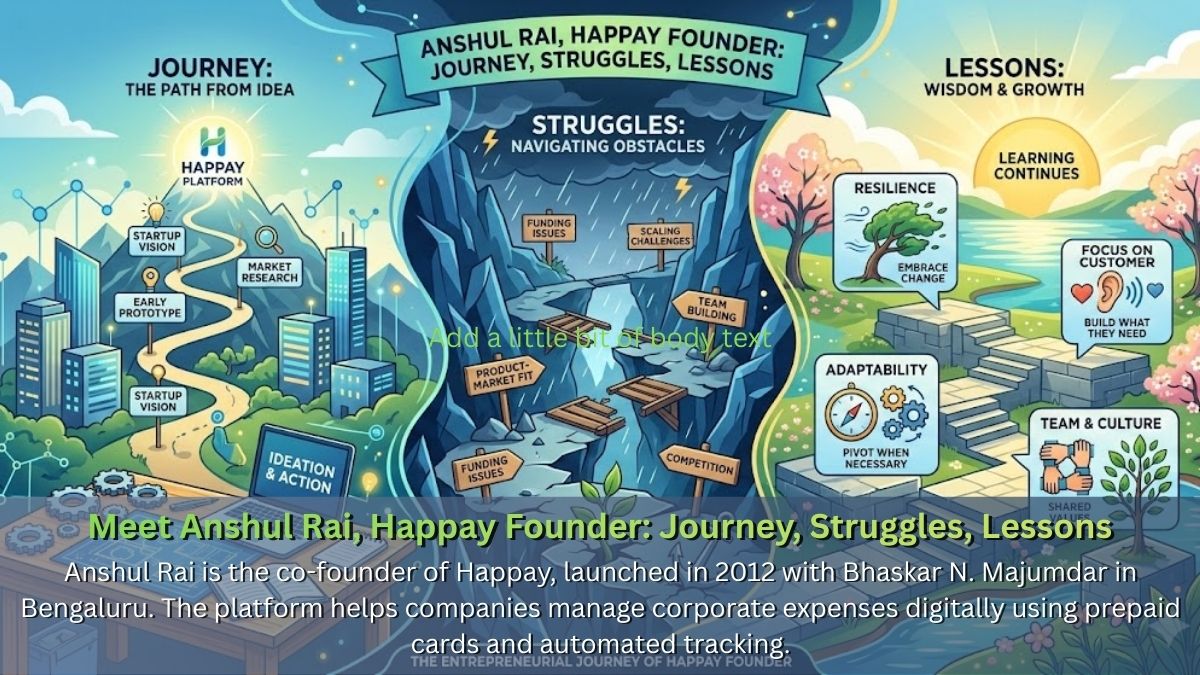
The story of Anshul Rai Happay founder reflects the rise of India’s modern fintech ecosystem and the transformation of corporate financial management through technology. Anshul Rai is the co-founder and former CEO of Happay, a Bengaluru-based fintech startup that built a digital platform for managing corporate expenses, travel payments, and financial workflows. Founded in 2012 along with Bhaskar N. Majumdar, Happay emerged during the early wave of financial technology startups in India and aimed to simplify how companies track and control employee spending.
Before becoming an entrepreneur, Anshul Rai worked in technology and enterprise software roles where he witnessed firsthand how inefficient and manual corporate expense processes were. Businesses relied heavily on paper receipts, spreadsheets, and delayed reimbursements, which created operational friction for both employees and finance teams. This insight eventually became the foundation for Happay’s product vision. Happay was launched in Bengaluru, India’s startup hub, and positioned itself as a corporate expense management software platform that integrates prepaid corporate cards, digital expense tracking, and automated approval workflows. The platform allowed companies to control spending in real time, eliminate manual reimbursements, and gain better visibility into financial data.
Over the years, Happay gained traction among startups
Over the years, Happay gained traction among startups, mid-sized enterprises, and large corporations across India. The company raised funding from investors such as Sequoia Capital India and Prime Venture Partners. Its technology-driven expense management platform became part of the broader shift toward digital finance operations within organizations.
A major turning point in the Happay founders story came in 2021 when the company was acquired by fintech company CRED. The Happay acquisition by CRED marked an important milestone, signaling consolidation in India’s fintech sector and the growing importance of enterprise financial tools. The Anshul Rai entrepreneur journey is therefore not just about building a startup but about identifying inefficiencies in corporate finance and creating technology solutions that redefine how businesses manage expenses in the digital era.
2. Background and Early Life
2.1 Early Life and Family Background
The Anshul Rai biography begins with a background shaped by technology and engineering. Anshul Rai grew up in India during a period when the country’s technology sector was beginning to gain global prominence. The rapid growth of the IT industry created opportunities for young engineers who were interested in building products and solving complex problems.
Although limited public information exists about his early family life, Rai has often spoken about being drawn toward technology from a young age. Curiosity about how digital systems work played a significant role in shaping his career direction.His early exposure to computing and software development later influenced his decision to pursue a career in technology-driven entrepreneurship.
2.2 Education and Early Influences
Anshul Rai studied computer science engineering, gaining technical expertise that would later become critical for building a fintech product. Engineering education in India typically emphasizes analytical thinking, system design, and problem solving. These skills became central to Rai’s approach as he began exploring opportunities in the technology sector.
During his student years, the global technology landscape was undergoing rapid transformation. Internet adoption, cloud computing, and mobile platforms were reshaping how businesses operated. For Rai, these technological shifts created a strong belief that software would play a central role in solving real-world business problems.
3. Founder and Company Overview
Anshul Rai is widely known as the co-founder and CEO of Happay, a fintech startup that focuses on corporate spending and expense management. Founded in 2012 in Bengaluru, Happay aimed to modernize how organizations manage employee spending, reimbursements, and travel expenses. The platform combined several financial tools into a single digital expense tracking solution. It offered prepaid corporate cards, mobile applications for submitting expenses, automated approval workflows, and analytics dashboards for finance teams.
Happay targeted startups, mid-sized companies, and large enterprises that struggled with manual expense tracking processes. Many organizations relied on email approvals, spreadsheets, and delayed reimbursements. This created inefficiencies and reduced financial visibility for finance teams. Happay attempted to solve this problem by building a corporate expense management software system that digitized the entire workflow. The company became part of the growing wave of fintech startup India ventures that aimed to bring technology into traditional financial processes. Over time, Happay expanded its product capabilities to include travel expense management, vendor payments, and integrated financial reporting tools.
4. The Problem, Insight, and Trigger
4.1 The Inefficiencies in Corporate Expense Management
Before the emergence of platforms like Happay, most companies handled expenses manually. Employees would collect paper receipts, fill reimbursement forms, and wait days or even weeks for approval and payment. Finance teams had to reconcile spreadsheets and manually verify receipts. This process was inefficient, time consuming, and prone to errors. For growing companies, the complexity increased significantly as employee expenses expanded across travel, procurement, and operational spending. Anshul Rai recognized that corporate finance operations lacked modern digital infrastructure. The opportunity to build an expense management platform capable of automating these workflows became the foundation of Happay’s business model.
4.2 The Trigger Behind the Startup Idea
The idea for Happay was shaped by Rai’s experience working with enterprise software and observing financial operations inside companies. He noticed that while many business functions were becoming digitized, expense management remained outdated. Employees continued to deal with reimbursement delays, while finance teams struggled with fragmented data. This realization led Rai to believe that there was space for a digital expense tracking solution that could integrate payments, approvals, and reporting into a single system. The insight eventually led to the creation of Happay.
5. Early Days and Initial Struggles
Building a fintech startup from scratch in 2012 was not easy. India’s fintech ecosystem was still emerging, and digital payments infrastructure was relatively underdeveloped. The Happay startup story began with the challenge of convincing companies to trust a new technology platform with their financial workflows. Many businesses were accustomed to traditional accounting systems and manual approval processes. Convincing finance teams to adopt a cloud-based expense platform required extensive education and demonstrations.
Another early challenge involved integrating payments infrastructure. Since Happay offered corporate prepaid cards linked to expense tracking software, the company had to collaborate with banks and payment networks. These integrations required regulatory approvals and technical partnerships. Operational complexity therefore became one of the earliest hurdles for the founders.
6. Failures, Setbacks, and Self Doubt
Every startup journey includes difficult phases, and the Anshul Rai entrepreneur journey was no exception. One of the toughest challenges involved building trust with enterprise clients. Unlike consumer startups where individual users can adopt products quickly, enterprise software requires multiple decision makers. Finance teams, HR departments, and leadership often need to approve new systems before adoption.
This created longer sales cycles and slower revenue growth during Happay’s early years. There were also moments when product features needed redesigning after feedback from early customers. For founders, these phases can create uncertainty about product direction and market fit. However, these challenges also helped Happay refine its offering.
7. Validation and Early Traction
Every startup eventually reaches a moment when an idea stops being a theory and starts becoming a real business. For Happay, that moment arrived when the first few companies began using the platform to manage employee expenses. What looked like a simple tool on the surface quickly started changing how finance teams operated. Employees could take a photo of receipts directly through the mobile app instead of storing paper bills for weeks. Finance teams no longer had to chase employees for missing expense reports or manually verify stacks of receipts. Suddenly, they could see company spending in real time.
That shift created something powerful: clarity. Managers could track travel expenses instantly. Finance leaders could identify unusual spending patterns. Employees could submit claims in minutes instead of hours. For many companies, the difference was immediate. Processes that once took days now happened within minutes. This early adoption proved something important for Happay. The product was not just convenient. It was solving a real operational problem that businesses had quietly struggled with for years. Word spread gradually.
Early customers shared their experiences with peers, and the platform began gaining traction across industries such as technology, consulting, and manufacturing. Each new client reinforced the same pattern. Once companies experienced the convenience of digital expense management, they rarely wanted to return to manual systems. For Anshul Rai, these early signals mattered more than any pitch deck or investor conversation. They confirmed that the product had genuine market demand.
8. Funding, Money, and the Reality of Growth
When startups begin showing real traction, investors start paying attention. As Happay’s customer base expanded, the company attracted venture capital from firms including Sequoia Capital India and Prime Venture Partners. For a growing fintech startup, this funding was essential. Building financial technology is not like launching a basic software application. It requires strong infrastructure, secure payment integrations, and strict compliance with financial regulations. Every feature must operate reliably because businesses depend on these systems for financial reporting and expense control.
The funding helped Happay strengthen its engineering team, improve the product’s technology architecture, and expand its sales operations. But capital also came with pressure. Scaling an enterprise fintech platform demands continuous investment. Infrastructure costs rise as transaction volumes grow. Security requirements become stricter. Product teams must constantly refine features to match evolving customer expectations.
Managing this balance between growth and financial discipline became one of the most important responsibilities for Rai and his leadership team. They had to think carefully about where to invest, how quickly to scale, and which opportunities truly supported the company’s long-term vision.
9. Team Building and Leadership Evolution
As Happay grew, the role of its founder began to change. In the early days, Anshul Rai was deeply involved in product development. He spent most of his time understanding customer problems and shaping how the platform should solve them. But as the company expanded, leadership required a different mindset. Suddenly there were engineering teams to manage, sales strategies to design, customer support systems to build, and operational processes to organize. The success of the company no longer depended only on the product. It depended on people.
Building the right team became one of the most difficult challenges. Startups operate in unpredictable environments. Roles evolve quickly, priorities change frequently, and resources are often limited. Hiring individuals who could thrive under those conditions required careful judgment. Over time, Happay built a team that blended different strengths. Engineers focused on building reliable fintech infrastructure. Sales teams worked closely with enterprises to understand their expense management needs. Customer success teams ensured that businesses could integrate the platform smoothly into their operations.
This combination of technology expertise and enterprise experience became a key part of the company’s growth strategy. Looking back, the evolution of Happay was not just about product innovation. It was also about leadership, resilience, and the ability to build a team that believed in the mission. And that belief is often what turns a promising startup into a lasting company.
10. Growth, Scaling, and Operational Challenges
Scaling a fintech platform is rarely a smooth journey. Unlike many software startups that only focus on product features, fintech companies must constantly balance innovation with regulation. As Happay expanded its customer base, the company entered a much more complex phase of growth. Building a product was only one part of the equation. Ensuring that every financial transaction met strict regulatory standards became equally important.
Operating in the payments ecosystem means working closely with banks, payment networks, and financial institutions. Each integration requires technical precision, compliance checks, and security safeguards. For the team, this meant product development could not move recklessly fast. Every new feature had to be designed with reliability, security, and regulatory compliance in mind. This discipline shaped Happay’s growth strategy.
Rather than building a single tool for expense tracking, the company gradually expanded its platform to support a broader range of financial workflows. Over time, new capabilities were introduced, including:
- travel expense management
- vendor payments
- procurement and spending controls
These additions transformed Happay from a simple expense reporting tool into a comprehensive corporate expense management platform. For businesses using the system, the benefit was clear. Finance teams could now manage multiple aspects of company spending within a single platform, improving visibility and control over financial operations. This evolution required patience, strong execution, and careful coordination between product teams, financial partners, and enterprise customers.
11. Personal Sacrifices and the Reality of Burnout
Behind every startup success story lies a quieter, more personal reality. Entrepreneurship demands an enormous emotional and mental investment. Founders often spend years working long hours, navigating uncertainty, and carrying the responsibility of building something from nothing. For Anshul Rai, leading a growing fintech company meant constantly balancing multiple pressures. There were employees depending on the company for their livelihoods. Customers expecting reliable products. There were investors looking for growth and strategic progress.
Every major decision carried weight. Startup leaders frequently operate under intense pressure, especially during periods of rapid growth. The responsibility of guiding a company through uncertainty can be exhausting, both mentally and emotionally. Many founders quietly experience moments of burnout along the way. Long nights spent solving operational challenges, difficult conversations with investors, and the constant need to make high-stakes decisions can take a personal toll. These experiences are rarely visible from the outside. Yet they form an important part of the entrepreneurial journey. Understanding this reality is essential because it reminds us that startup success is not only about innovation or funding. It is also about resilience, perseverance, and the ability to keep moving forward despite setbacks.
12. Lessons, Beliefs, and Values
Over the years, Anshul Rai has often reflected on the lessons learned while building Happay. One of the most important insights he shares is surprisingly simple: focus on real problems. Many startups begin by chasing market trends or popular technologies. But companies that endure usually start with a genuine problem that customers urgently want solved. Happay’s success came from addressing a challenge that finance teams faced every day. Expense reporting was inefficient, manual, and frustrating. By simplifying that process, the company created immediate value for businesses.
Another principle Rai often emphasizes is product simplicity. Enterprise software has a reputation for being complicated and difficult to use. Rai believed that even complex financial tools should feel intuitive for employees. When products are simple to use, adoption becomes easier. Employees use them willingly instead of avoiding them. Finally, the Happay journey highlights the importance of persistence.
Unlike consumer apps that can grow rapidly, enterprise products often require longer sales cycles. Companies take time to evaluate new software, integrate it into existing systems, and train employees. For founders building B2B platforms, patience becomes an essential quality.
Growth may feel slow at times, but consistent improvement and strong customer relationships eventually create momentum.
Looking back, the story of Happay is not just about building fintech software. It is about the discipline of solving meaningful problems, the resilience required to navigate uncertainty, and the belief that thoughtful products can quietly transform how businesses operate.
13. Present Challenges and Future Vision
A major milestone in the Happay startup story came in 2021 when the company was acquired by fintech company CRED. The Happay acquisition by CRED represented a strategic move to strengthen enterprise financial services within CRED’s ecosystem. Happay’s technology platform complemented CRED’s vision of expanding beyond consumer credit into broader financial products. For Anshul Rai, the acquisition marked the culmination of nearly a decade of building a fintech platform from the ground up.
The story of Anshul Rai Happay founder therefore reflects the evolution of India’s fintech landscape. Enterprise financial tools are becoming increasingly important as businesses digitize their operations. Expense management platforms like Happay represent a shift toward real-time financial visibility and automated workflows. The future of this sector will likely involve deeper integrations with banking systems, artificial intelligence driven financial insights, and cross-border payment capabilities.
Future Outlook
The journey of Anshul Rai Happay founder offers valuable lessons for entrepreneurs building technology companies in complex industries. The Happay founder Anshul Rai story shows how identifying inefficiencies in everyday business processes can lead to powerful startup ideas.
Happay’s success also highlights the growing demand for enterprise financial technology in India’s digital economy. As companies increasingly adopt automation and data-driven financial systems, the role of platforms like Happay will continue expanding. For aspiring founders, the Anshul Rai entrepreneur journey demonstrates that persistence, product focus, and deep understanding of customer problems remain essential ingredients for building successful startups.
About foundlanes.com
foundlanes.com is India’s leading startup idea discovery platform. It helps entrepreneurs find actionable startup opportunities, market insights, and industry-specific guidance to turn ideas into real businesses. With deep research and practical resources, foundlanes supports founders at every stage, from idea validation to launch and growth.