Summary
The story of Ashish Goel Urban Ladder represents one of the most widely discussed entrepreneurial journeys in India’s modern startup ecosystem. Ashish Goel is the co-founder of Urban Ladder, an Indian online furniture retailer that attempted to transform how urban consumers buy furniture in a market traditionally dominated by unorganized offline sellers. Founded in 2012 along with Rajiv Srivatsa, Urban Ladder emerged during the early growth phase of India’s ecommerce revolution and aimed to build a reliable, design-focused furniture brand that could be trusted by online shoppers.
Ashish Goel comes from an engineering and consulting background. Before entering entrepreneurship, he worked with McKinsey & Company, where he gained exposure to global business strategy and operations. It was during this time that he recognized inefficiencies in India’s furniture retail market, especially around product discovery, quality assurance, and delivery reliability. Traditional furniture purchases often involved long lead times, limited design choices, and poor customer experience.
Urban Ladder was founded in Bengaluru with the goal of solving these problems through an online furniture startup India model. The company offered curated furniture collections, transparent pricing, professional delivery services, and a digital-first shopping experience. Urban Ladder quickly gained attention in India’s growing Indian ecommerce furniture market, attracting venture capital from global investors including Sequoia Capital and SAIF Partners.
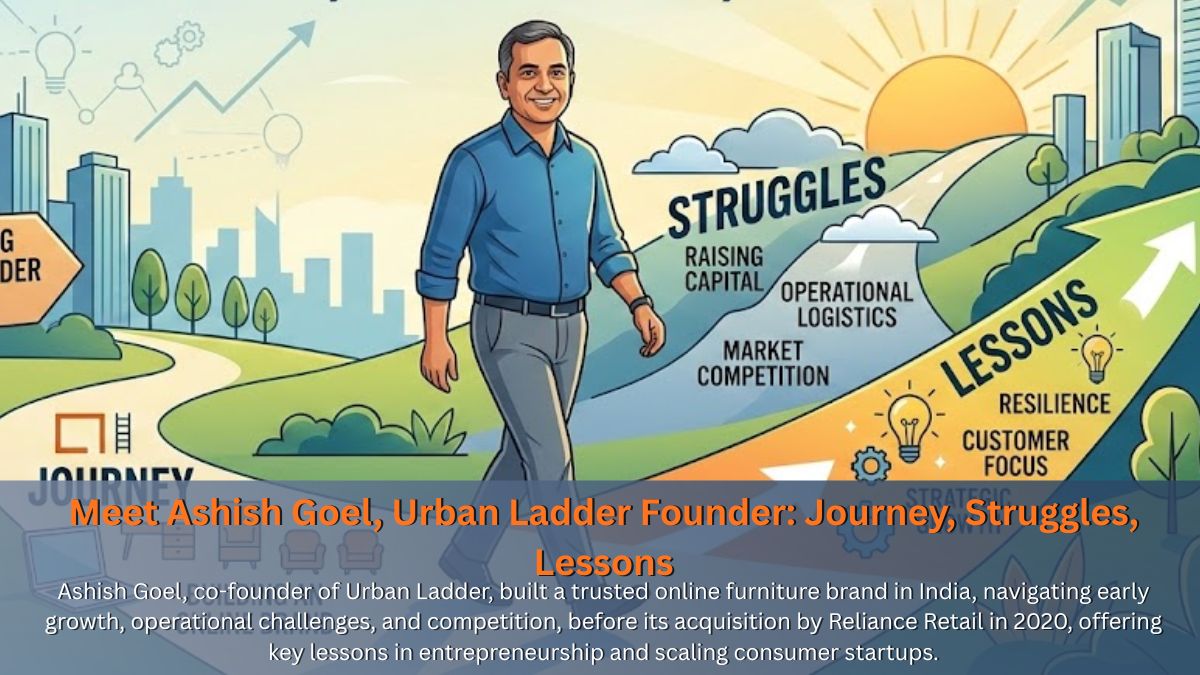
Despite strong early growth and significant funding rounds, Urban Ladder’s journey was not without challenges. The company faced operational complexities, rising logistics costs, and intense competition from other ecommerce players. Eventually, the company was acquired by Reliance Retail in 2020 in a deal widely reported as part of Reliance’s expansion into online furniture and home decor. This Urban Ladder founder Ashish Goel story offers valuable insights into entrepreneurship, market timing, and the realities of scaling consumer startups in India. The journey includes moments of success, strategic pivots, and difficult lessons about building sustainable ecommerce businesses in emerging markets.
2. Background and Early Life
2.1 Early Life and Education
The Ashish Goel biography begins with a strong academic foundation shaped by India’s competitive education system. Ashish Goel studied engineering at the Indian Institute of Technology (IIT) Bombay, one of India’s most prestigious engineering institutions. His time at IIT exposed him to analytical problem-solving and the culture of innovation that later influenced his entrepreneurial thinking.
After completing his undergraduate degree, Goel pursued further education at the Indian Institute of Management (IIM) Bangalore. This combination of engineering and business education provided him with a rare mix of technical and managerial expertise.
2.2 Early Professional Experience
Before launching Urban Ladder, Ashish Goel worked with McKinsey & Company, a global management consulting firm. Consulting exposed him to various industries and business models, helping him understand how large organizations approach strategy and operations. It was during these years that Goel developed a deep interest in entrepreneurship and consumer markets.
Working with global clients also allowed him to observe how digital platforms were transforming traditional industries. These experiences would later influence his decision to enter the Indian ecommerce furniture market.
3. Founder and Company Overview
Ashish Goel co-founded Urban Ladder in 2012 along with Rajiv Srivatsa. Urban Ladder was designed as an online furniture startup India focused on creating high-quality, design-led furniture products for urban consumers. The company positioned itself as a premium furniture brand that offered curated collections instead of the overwhelming catalog-style approach used by many marketplaces.
Urban Ladder’s product categories included living room furniture, bedroom furniture, dining tables, storage units, and home decor accessories. The target audience consisted primarily of urban middle-class and upper-middle-class households that were comfortable shopping online. Urban Ladder aimed to combine ecommerce convenience with the reliability and service standards expected from premium furniture brands. This positioning became a central element of the Urban Ladder growth strategy.
4. The Problem, Insight, and Trigger
4.1 The Market Gap in Indian Furniture Retail
Before Urban Ladder launched, India’s furniture industry was largely fragmented and unorganized. Most consumers purchased furniture from local carpenters or neighborhood stores with limited product variety. Quality standards varied widely, and delivery timelines were often unpredictable.
Consumers also had limited access to modern furniture designs that matched contemporary urban homes. Ashish Goel recognized that the Indian ecommerce furniture market had the potential to transform this experience.
4.2 The Trigger Moment
The founders reportedly experienced frustration while trying to buy furniture themselves. The process involved visiting multiple stores, negotiating prices, and waiting weeks for delivery. This personal experience reinforced their belief that a digital platform could simplify the furniture buying process. Urban Ladder was therefore built as a solution to improve transparency, design quality, and customer experience.
5. Early Days and Initial Struggles
In the early days of Urban Ladder, the excitement of building something new was constantly matched by the weight of reality. On the surface, the idea seemed simple, sell furniture online. But once the work began, it became clear that this was one of the hardest categories to crack in ecommerce. Furniture is not a plug-and-play product. It’s large, heavy, fragile, and deeply personal. Every single order came with risk. A small mistake in packaging or handling could turn into a damaged product, a frustrated customer, and a loss of trust that was hard to recover. Logistics wasn’t just a backend function, it was the business.
For Ashish Goel and his co-founder, building a reliable delivery network from scratch was one of the toughest early battles. There was no ready-made infrastructure they could plug into. They had to figure out warehousing, transportation, and last-mile delivery step by step, often learning through mistakes that were both costly and exhausting. At the same time, supply wasn’t easy either. They needed manufacturers who could deliver consistent quality at scale, not just once, but repeatedly. That meant building relationships, aligning expectations, and sometimes dealing with delays or inconsistencies that directly affected customers.
And then came the biggest challenge of all, trust. Convincing someone to buy a sofa or a bed online, without touching it, sitting on it, or seeing it in real life, felt like asking a lot. The team knew this hesitation was real, so they leaned into it. They invested heavily in high-quality product photography, detailed descriptions, and responsive customer support. They tried to recreate the in-store experience through a screen, knowing it would never be perfect, but determined to make it good enough for people to take that leap of faith. Those early days were not smooth or glamorous. They were full of small wins, constant firefighting, and a quiet determination to keep going.
6. Failures, Setbacks, and Self Doubt
The journey of Ashish Goel was never a straight line upward. For every moment of progress, there were phases where things felt uncertain, even fragile. As Urban Ladder started scaling, costs began to rise faster than expected. Logistics became more complex, warehousing needed expansion, and maintaining quality across a growing catalog became harder. What worked at a smaller scale didn’t always hold up when volumes increased. Competition added another layer of pressure. Large marketplaces with deeper pockets entered the furniture space, often competing aggressively on pricing and convenience. Suddenly, it wasn’t just about building a good product, it was about surviving in an increasingly crowded market.
There were also strategic bets that didn’t play out as smoothly as hoped. The move into offline retail, for example, was an attempt to bridge the trust gap and give customers a physical touchpoint. It made sense in theory. In practice, it required heavy investment, operational adjustments, and a completely different way of thinking about retail. These are the moments that don’t get highlighted enough, the quiet phases where founders question their decisions. Self-doubt creeps in, not because of a lack of belief, but because the stakes are so high. Every decision carries consequences, and there’s no clear playbook to follow. For Goel, these weren’t just business challenges. They were deeply personal moments of reflection, where he had to keep moving forward even when clarity wasn’t always there.
7. Validation and Early Traction
And then, slowly, things started to shift. Urban Ladder began to find its footing, especially among urban customers who were looking for something different from traditional furniture options. The focus on clean design, curated collections, and a more modern aesthetic started resonating. It wasn’t just about selling furniture anymore, it was about offering a lifestyle choice. Customers noticed the effort. The delivery and installation experience, which could have easily been a weak point, became one of the company’s strengths. When people received their orders on time, in good condition, and with professional installation, it built a sense of reliability that was rare in the category.
Word-of-mouth played a powerful role here. One satisfied customer often led to another. In a market where online furniture shopping was still new and slightly intimidating, these real experiences mattered more than any marketing campaign. This early traction wasn’t explosive, but it was meaningful. It gave the founders confidence that they were solving a real problem in the right way. It validated the Urban Ladder business model, not through vanity metrics, but through genuine customer trust. With that confidence, the company began expanding, adding more products, reaching more cities, and slowly building a recognizable brand in the Indian ecommerce space.
8. Funding, Money, and Growth Constraints
As the business grew, so did the need for capital. Scaling a company like Urban Ladder is expensive, there’s no way around it. Inventory, warehouses, logistics, technology, marketing, everything requires significant investment. Urban Ladder raised funding from well-known investors like Sequoia Capital, SAIF Partners, and Kalaari Capital. These weren’t just financial boosts, they were signals of belief in the company’s vision. But funding comes with its own kind of pressure. It brings expectations, timelines, and the need to show rapid growth. Suddenly, decisions are not just about what’s right for the business, but also about how quickly it can scale.
For Urban Ladder, this created a delicate balance. On one hand, they needed to grow fast to capture market share. On the other, the nature of the business demanded careful execution. You can’t rush logistics without consequences. You can’t compromise on quality without losing trust. Managing this tension became one of the hardest parts of the journey. Growth required spending, but spending increased risk. Every expansion, whether in inventory, infrastructure, or marketing, had to be thought through, knowing that mistakes at this scale could be expensive.
These were not just financial decisions, they were strategic bets that shaped the future of the company. And like most startup journeys, some worked, some didn’t, but each one added to the experience and understanding of what it really takes to build a business like this.
9. Team Building and Leadership Evolution
As Ashish Goel moved beyond the early hustle of building Urban Ladder, his role quietly but fundamentally changed. In the beginning, it was about doing everything yourself, obsessing over product listings, customer emails, even packaging decisions. But growth doesn’t reward control, it demands trust. That transition is never easy. Letting go is uncomfortable, especially when you’ve built something from scratch. Goel had to move from being the person who executes to the person who enables execution. This meant hiring leaders who were often better than him in specific domains, product designers who understood aesthetics at scale, supply chain experts who could fix delivery inefficiencies, and marketers who could shape the brand voice.
But building a team is not just about hiring talent. It’s about alignment. Early on, every decision reflects the founder’s instinct. As teams grow, that instinct has to be translated into systems, culture, and shared thinking. Goel had to learn how to communicate vision clearly, step back without disconnecting, and most importantly, trust people even when outcomes weren’t perfect. That shift, from founder to leader, is where many startups struggle. For Urban Ladder, it became one of the defining phases of its journey.
10. Growth, Scaling, and Operational Challenges
Urban Ladder’s rise happened alongside the explosion of ecommerce in India. Demand was growing fast, customer expectations were rising even faster, and the company had to keep up. Scaling wasn’t just about selling more furniture, it meant rethinking how the entire business operated. Furniture is not like selling books or electronics. It’s bulky, fragile, and expensive to move. Every order involves warehousing, careful handling, and last-mile delivery that directly impacts customer experience. A delayed or damaged product doesn’t just hurt revenue, it damages trust.
Urban Ladder invested heavily in logistics and infrastructure to control this experience. They expanded product categories, experimented with offline stores, and tried to build a more integrated retail model. On paper, it looked like the right move. In reality, it brought layers of complexity. Costs increased. Inventory management became tougher. And competition wasn’t standing still. Large marketplaces with deep pockets entered the category, often competing aggressively on price.
This is where the reality of scaling hit hard. Growth is exciting, but it exposes every weakness in your system. Urban Ladder had to constantly refine its strategy, balancing expansion with efficiency, ambition with sustainability.
11. Personal Sacrifices and Burnout
Behind every growth chart is a very human story. And that story is rarely as smooth as it looks from the outside. For Ashish Goel, building Urban Ladder wasn’t just a professional journey, it demanded personal trade-offs. Long hours became the norm. Weekends blurred into workdays. The pressure wasn’t just about running a company, it was about meeting investor expectations, managing teams, solving operational fires, and still thinking about the future.
There’s also an emotional weight that comes with leadership. Every decision affects people, employees, customers, stakeholders. That responsibility doesn’t switch off at the end of the day. Burnout isn’t always dramatic. Sometimes it’s quiet, it builds slowly through constant stress, difficult decisions, and the feeling of always being “on.” Many founders go through it but rarely talk about it openly. Goel’s journey reflects this reality. The success, the growth, and the recognition came with moments of exhaustion, doubt, and intense pressure. It’s a reminder that entrepreneurship is as much an emotional challenge as it is a business one.
12. Lessons, Beliefs, and Values
Over time, certain lessons become clear, not because they are taught, but because they are lived. One of the strongest beliefs that shaped Urban Ladder was an obsession with customer experience. In the early days, this focus helped the brand stand out. Good design, reliable delivery, and a smooth buying experience built trust in a category where trust was often missing. Another hard-earned lesson was about operational discipline. Growth without control can quickly become a liability. For consumer startups, especially in categories like furniture, margins are tight and mistakes are expensive. Goel learned that ambition needs to be backed by strong processes and realistic execution.
Then there’s the importance of people. No company scales without a team that believes in the vision. Empowering employees, giving them ownership, and creating a culture of accountability became central to how Urban Ladder operated. These aren’t theoretical ideas. They are lessons shaped by real decisions, real mistakes, and real outcomes.
13. Present Challenges and Future Vision
In 2020, Urban Ladder reached a turning point when it was acquired by Reliance Retail. This wasn’t just a financial transaction, it marked the end of one phase and the beginning of another. For Ashish Goel, the acquisition carried mixed emotions. On one hand, it validated years of effort and built a path for the brand to survive and grow within a larger ecosystem. On the other, it meant letting go of something he had built from the ground up. Under Reliance, Urban Ladder gained access to a broader retail network, deeper resources, and the ability to integrate online and offline experiences at scale. It gave the brand a second life in a highly competitive market.
At the same time, the journey highlights a deeper truth about startups. Not every story ends with massive independence or dominance. Sometimes success is about finding the right partner at the right time. Today, the furniture ecommerce space in India continues to evolve, shaped by changing consumer behavior, digital adoption, and new business models. Urban Ladder remains a part of that story, even as its role has changed. The journey of Ashish Goel is not just about building a company. It’s about navigating uncertainty, learning through pressure, and evolving with every stage. It shows that entrepreneurship is rarely linear. It’s messy, demanding, and deeply personal, but that’s exactly what makes it meaningful.
Future Outlook
The journey of Ashish Goel Urban Ladder offers important lessons for entrepreneurs building startups in emerging markets. The Urban Ladder startup story highlights how founders can identify gaps in traditional industries and attempt to transform them using technology. However, the journey also demonstrates that scaling consumer ecommerce businesses requires operational excellence, capital discipline, and adaptability.
India’s furniture retail sector continues to evolve as digital platforms and omnichannel strategies reshape how consumers shop. The legacy of Urban Ladder lies in its attempt to modernize the Indian ecommerce furniture market and introduce design-led furniture retail to online consumers. For aspiring founders, the Ashish Goel entrepreneur journey serves as a reminder that startup success is rarely linear. It is often defined by experimentation, setbacks, and resilience.
About foundlanes.com
foundlanes.com is India’s leading startup idea discovery platform. It helps entrepreneurs find actionable startup opportunities, market insights, and industry-specific guidance to turn ideas into real businesses. With deep research and practical resources, foundlanes supports founders at every stage, from idea validation to launch and growth.