Summary
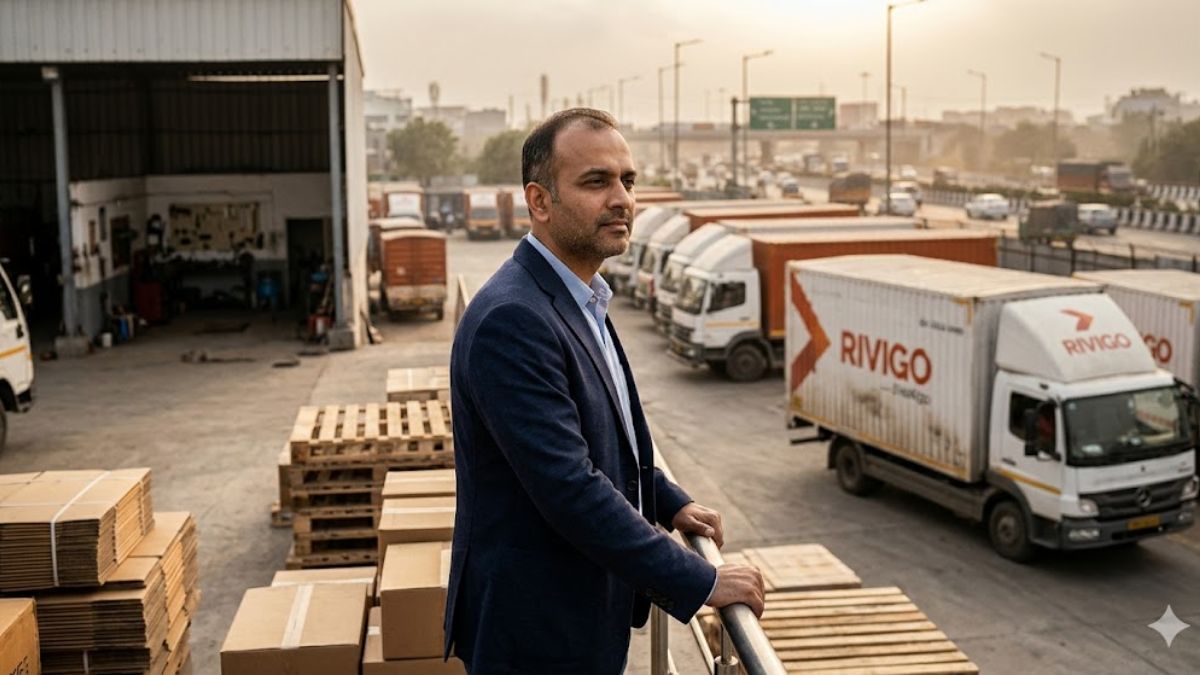
India’s logistics industry has historically been complex, fragmented, and inefficient. Long before the rise of digital platforms and supply chain automation, trucking operations relied heavily on manual coordination, long driver shifts, and inconsistent delivery timelines. It was within this challenging ecosystem that Deepak Garg emerged as a transformative entrepreneur. Deepak Garg is best known as the founder of Rivigo, a company that reimagined trucking operations through technology and an innovative relay-based transportation system. Founded in 2014 and headquartered in Gurugram, Rivigo introduced the concept of relay trucking in India, a model that allows truck drivers to swap routes at relay points instead of driving across the country nonstop.
The idea emerged from Garg’s observation of the structural problems in India’s trucking sector: exhausted drivers, delayed deliveries, inefficient fleet usage, and lack of technological integration. Through Rivigo, he attempted to solve these challenges by building a logistics technology platform designed to optimize routes, reduce driver fatigue, and improve supply chain efficiency. Within a few years, Rivigo attracted major investors and became one of the most talked-about logistics tech startups in India. The startup’s relay trucking model promised faster delivery times and a more humane working environment for drivers. Companies across e-commerce, FMCG, and manufacturing sectors began experimenting with Rivigo’s platform.
Yet the journey was far from smooth. Garg and his team faced operational complexities, massive infrastructure challenges, capital pressures, and leadership evolution as the startup scaled. Rivigo’s story is therefore not just a case study in logistics innovation but also a human story of resilience, experimentation, and relentless problem-solving. The journey of the Deepak Garg Rivigo founder story offers insights into entrepreneurship, supply chain innovation, leadership growth, and the realities of building a technology platform in one of India’s most traditional industries.
1. Background and Early Life
1.1 Early Life and Family Background
Deepak Garg was born and raised in India in a family that valued education and intellectual curiosity. From an early age, he demonstrated strong analytical abilities and a natural interest in solving complex problems. Growing up, Garg was exposed to an environment that encouraged disciplined thinking and academic excellence. Like many ambitious Indian students, he pursued higher education with the aim of building a meaningful career in technology and innovation. His formative years were shaped by curiosity about systems and efficiency. While logistics was not initially part of his career ambitions, his ability to observe patterns and inefficiencies would later become central to the creation of Rivigo.
1.2 Education and Early Influences
Deepak Garg studied computer science at the prestigious Indian Institute of Technology Delhi, one of India’s top engineering institutions. IIT Delhi has historically produced many entrepreneurs who later built influential technology companies. At IIT, Garg was exposed to rigorous problem-solving methodologies and engineering thinking. The environment encouraged experimentation, innovation, and entrepreneurial ambition.
After completing his undergraduate degree, he continued his academic journey at the globally respected Massachusetts Institute of Technology. Studying at MIT broadened his global perspective and strengthened his exposure to technology-driven entrepreneurship. The combination of IIT Delhi’s analytical rigor and MIT’s innovation-driven culture played a key role in shaping Garg’s entrepreneurial mindset.
2. Founder and Company Overview
2.1 Introduction to the Founder
The Deepak Garg Rivigo founder journey is rooted in a rare combination of engineering expertise, consulting experience, and real-world observation of systemic inefficiencies. Before becoming an entrepreneur, Garg worked as a consultant at McKinsey & Company. During his consulting career, he worked on large-scale business strategy and operational improvement projects. This experience exposed him to the structural problems faced by large organizations, including inefficiencies in logistics and supply chain networks. It also helped him develop the strategic thinking required to build scalable businesses.
2.2 Company Overview and Offerings
Rivigo is a logistics technology platform designed to improve trucking efficiency and supply chain reliability. The startup introduced a technology-driven approach to logistics operations. Instead of traditional trucking methods, Rivigo built a digital platform that integrates route optimization, fleet management, and driver coordination. The company became known for its relay trucking model, a unique operational system in which drivers operate within shorter segments rather than traveling across the entire route. This model improved delivery speed, reduced driver fatigue, and optimized vehicle utilization.
2.3 Target Audience and Market Served
Rivigo primarily serves businesses that depend heavily on logistics networks.
These include:
- E-commerce companies
- FMCG brands
- Retail distribution networks
- Manufacturing supply chains
India’s logistics industry represents a massive market opportunity. Inefficiencies in trucking, warehousing, and route planning have historically increased supply chain costs. Rivigo positioned itself as a solution provider for businesses seeking technology-enabled logistics services.
2.4 Year of Founding and Business Stage
Rivigo was founded in 2014 in Gurugram. Within a few years, the startup attracted funding from global investors and expanded its logistics network across major Indian cities. Its rapid rise made it one of the most closely watched logistics tech startups in India.
3. The Problem, Insight, and Trigger
3.1 Core Problem Identified
The Indian trucking industry suffers from several systemic challenges. Drivers often travel thousands of kilometers without rest. Long driving hours cause fatigue, safety risks, and unpredictable delivery timelines. Logistics companies also struggle with poor fleet utilization and inefficient routing. These structural issues create delays, increase operational costs, and reduce reliability for businesses.
3.2 Personal Insight Behind the Idea
During his time working with companies on operational improvements, Deepak Garg observed how inefficient logistics networks could affect entire industries. He realized that the trucking sector in India had remained largely untouched by modern technology. This insight sparked the idea of creating a technology-driven logistics platform that could transform how trucking networks operate.
3.3 Trigger Moment to Start
The Deepak Garg entrepreneur journey moved toward entrepreneurship when he began deeply analyzing the human side of the trucking industry. Truck drivers often spent weeks away from home. Many faced exhausting working conditions with limited rest or predictable schedules. Garg believed that solving logistics inefficiencies while improving driver working conditions could unlock a powerful business opportunity. This belief ultimately led to the founding of Rivigo.
4. Early Days and Initial Struggles
4.1 Early Assumptions and Naivety
Like many startup founders, Garg initially underestimated the complexity of the logistics sector. The trucking industry involves numerous stakeholders including drivers, fleet owners, warehouse operators, and corporate clients. Building coordination between these groups required more operational sophistication than initially expected.
4.2 Entrepreneurial Initial Struggles
In the early days of Rivigo, the team had to build logistics infrastructure from scratch. Relay stations needed to be designed and implemented across different routes. Technology systems also had to integrate seamlessly with real-world operations. Convincing businesses to trust a new logistics model was another challenge.
4.3 What Turned Out to Be Harder Than Expected
Operational execution proved to be far more difficult than conceptualizing the idea. Scaling logistics infrastructure requires massive coordination. Every route expansion involves planning hubs, driver rotations, vehicle tracking systems, and operational support. For a startup operating in a traditional industry, these challenges were even more significant.
5. Failures, Setbacks, and Self Doubt
5.1 Toughest Phase of the Journey
The early growth stage often tests the resilience of startup founders. For the Deepak Garg Rivigo founder story, the toughest phases involved balancing growth ambitions with operational stability. Rapid expansion can sometimes create internal strain within logistics networks.
5.2 Early Failures and Major Setbacks
In the early days, Rivigo faced challenges that tested both the technology and the team’s resilience. Route optimization models, which were supposed to streamline trucking schedules, often failed when confronted with real-world unpredictability: sudden traffic snarls, last-minute shipment changes, and driver availability fluctuations. Every failed experiment forced the team to step back, analyze, and tweak the algorithms repeatedly.
Technology integration, too, was never smooth. Systems that worked perfectly in the lab often crashed in field conditions. GPS trackers malfunctioned, mobile apps froze under heavy data loads, and relay points had to be constantly reorganized. Each setback was not just a technical problem it was a human test. Drivers, warehouse staff, and operations managers had to adapt to constantly evolving processes, which required patience and careful communication. Yet, these failures were invaluable. They became a masterclass in iterative learning. With each operational hiccup, the team gained deeper insight into what the logistics network truly needed. Patterns emerged, efficiencies were discovered, and slowly, the relay model started proving its potential.
5.3 Moments of Self-Doubt and Emotional Lows
Entrepreneurship is an emotional rollercoaster, and Rivigo’s early days were no exception. Garg has often spoken candidly about the emotional weight of being responsible for dozens of employees, hundreds of drivers, and the expectations of investors who believed in the vision. There were nights when the numbers didn’t add up, when technology failed mid-route, or when a client threatened to switch providers.
In these moments, self-doubt would creep in. Could this ambitious idea truly disrupt the trucking industry? Was the relay model scalable enough? The pressure was intense, and the founder’s role felt isolating. There was no one to shoulder the responsibility but himself. Yet, these lows also sparked clarity. The fear of failure sharpened problem-solving instincts, reinforced perseverance, and deepened empathy for the people on the ground. Every emotional setback became a lesson in resilience, teaching the team how to face uncertainty without losing focus.
6. Validation and Early Traction
6.1 First Real Validation
The first real validation for Rivigo came not from awards or press coverage, but from tangible operational results. Businesses that partnered with Rivigo began to notice faster delivery times almost immediately. The relay model designed to shorten driver shifts while keeping trucks on the move nearly 24/7 was transforming logistics into something predictable and reliable. For the founders, this was electrifying. It was proof that the model was not just a theory but a working system that could tackle the inefficiencies of traditional trucking. Seeing trucks move seamlessly across relay points, meeting delivery timelines consistently, was the first real evidence that Rivigo could change the industry.
6.2 Early Revenue Growth and Customer Feedback
Positive client feedback started trickling in. Businesses appreciated not just speed, but predictability. Shipments arrived on time, customer complaints dropped, and operational bottlenecks eased. Early revenue growth, though modest, reinforced the idea that technology-driven logistics could be commercially viable. These first few clients became advocates. Their success stories were not marketing fluff they were living proof of Rivigo’s impact. Every testimonial was a morale booster for the team and a real-world indicator that the concept had legs.
6.3 Why This Moment Changed Belief
For founders, early validation is more than numbers it is a moment of psychological transformation. For Garg and the team, seeing clients trust Rivigo’s system and rely on it for critical shipments confirmed the problem they were solving was real. It shifted the mindset from hopeful experimentation to purposeful execution. Early adoption validated the approach, cemented belief in the relay model, and demonstrated that technology could reshape an industry long resistant to change. It was a pivotal turning point, one that transformed doubt into determination.
7. Funding, Money, and Growth Constraints
7.1 Bootstrapped or Funded Journey
Scaling a logistics platform is capital intensive. Rivigo attracted backing from prominent investors, providing the fuel to expand infrastructure, acquire trucks, and enhance technology. These funds allowed the company to test new routes, hire skilled talent, and refine operational systems at a scale impossible on bootstrapped resources alone.
7.2 Capital Challenges and Cash Flow Issues
Even with funding, financial management remained a tightrope. Logistics operations involve high fixed costs: vehicles, technology, driver salaries, and relay hubs. Cash flow had to be meticulously monitored to ensure operations never stalled. At times, payroll, fuel, or maintenance bills coincided with slow client payments, creating tense moments of worry and sleepless nights. This constant pressure forced the team to develop financial discipline and creative solutions, like optimizing route efficiency and staggered funding use, ensuring sustainability while growth remained a priority.
7.3 Early Growth Limitations
Expansion was never linear. Each new route required trucks, trained staff, relay points, and technology updates. Scaling too fast risked operational breakdowns; scaling too slowly risked losing market opportunities. Garg had to balance ambition with practicality, making tough calls about where and when to grow. The limitation was not desire it was logistics itself. But these constraints shaped stronger systems, sharper planning, and a culture of operational discipline that would later become Rivigo’s backbone.
8. Team Building and Leadership Evolution
8.1 Early Hiring Mistakes
Finding the right team proved challenging. Early hires sometimes lacked the right mix of logistics knowledge and technology understanding. Mistakes were inevitable some roles had to be redefined, some employees repositioned, and occasionally, parting ways became necessary. Yet, these experiences taught Garg valuable lessons about alignment, culture, and identifying people who could thrive in ambiguity. Hiring was no longer transactional; it became strategic.
8.2 Delegation Challenges
Initially, Garg wore multiple hats operations, technology oversight, client communication, and team management. The transition from hands-on problem solving to strategic leadership was difficult. Letting go of control and trusting the team was a process filled with doubt, but necessary. Delegation became a cornerstone of leadership. By empowering capable team members, Garg could focus on growth, innovation, and systemic improvements. It was a hard but transformative learning curve.
8.3 Leadership Learnings Over Time
Leadership at Rivigo evolved through experience, mistakes, and reflection. Garg’s style became defined by operational discipline, a problem-solving mindset, and empathy for both employees and customers. The journey taught him that true leadership is not about authority it is about responsibility, resilience, and the ability to guide a team through uncertainty while keeping the vision intact. These lessons helped Rivigo navigate one of the most complex logistics challenges in India, turning early setbacks into a platform for long-term success.
9. Growth, Scaling, and Operational Challenges
9.1 Brand Positioning and Go-to-Market Learnings
From the outset, Rivigo set itself apart by positioning as a technology-first logistics company rather than just another trucking operator. This was not a marketing gimmick it reflected a strategic understanding that the logistics industry was ripe for modernization. Clients were increasingly looking for reliability, predictability, and visibility things traditional operators struggled to provide. By emphasizing data-driven route management, real-time tracking, and the relay model, Rivigo attracted businesses that valued efficiency over legacy practices.
This positioning also shaped internal culture. Teams were encouraged to think like engineers and problem-solvers rather than simply managing trucks. This mindset paid off when early clients noted fewer delivery delays, better tracking visibility, and smoother communication with the operations team.
9.2 Scaling Challenges
Scaling Rivigo’s network was far from simple. Each additional route introduced layers of complexity: more trucks, drivers, relay points, and client expectations. One misstep a delayed shipment or a mismanaged relay point could ripple across multiple routes. Early attempts at rapid expansion revealed the fragility of manual processes. Systems that worked for 50 trucks failed under the load of 500. Garg and his team had to build scalable infrastructure, refine standard operating procedures, and create redundancies to prevent breakdowns. Despite challenges, the results justified the effort. Over time, new routes began to operate with near the same efficiency as the original network, proving that technology paired with disciplined operations could scale logistics in a way previously thought impossible in India’s fragmented trucking industry.
9.3 Operational Breakdowns and Fixes
Operational issues were inevitable. Trucks broke down mid-route, GPS trackers lost signals, and unexpected traffic snarls disrupted carefully planned schedules. Each breakdown was a test of the team’s ability to respond quickly and intelligently. Rivigo invested heavily in technology: advanced data analytics, AI-driven route optimization, and sophisticated driver management systems. Real-time dashboards alerted operations teams to delays, enabling proactive fixes. Driver shifts were optimized to prevent fatigue, and relay hubs were strategically placed to maximize uptime.
Over time, these measures not only fixed problems but built resilience into the system. The company learned that operational reliability is not just about technology it’s about building processes that anticipate errors, empower teams to respond quickly, and maintain service continuity even under pressure.
10. Personal Sacrifices and Burnout
10.1 Personal Costs of Entrepreneurship
Founding Rivigo demanded sacrifices that were deeply personal. For Deepak Garg, it meant years of 16-hour days, constant travel to manage trucks, hubs, and teams, and near-constant mental engagement with operational and strategic issues. Every decision carried weight one misstep could affect thousands of shipments, tens of employees, and dozens of investors. The burden of responsibility was constant, and the personal cost was real: missed family events, delayed personal milestones, and long stretches away from home.
10.2 Burnout Phases and Emotional Pressure
There were periods when the pressure felt unbearable. Investor expectations, operational failures, and the relentless pace of growth created emotional strain. Nights were often spent troubleshooting logistics breakdowns, managing client crises, or reconsidering strategic plans. These moments brought self-doubt, frustration, and exhaustion. Yet, they also became crucibles for learning. Deepak realized that resilience was as important as strategy, and that emotional intelligence was critical for leading teams under pressure.
10.3 Impact on Personal Life
Entrepreneurship demanded sacrifices in personal time and stability. Social events were skipped, vacations postponed, and personal relationships tested. Yet, there was also a deep sense of purpose. Garg’s commitment to solving systemic problems in India’s logistics industry gave him the emotional fuel to persist despite personal costs.
11. Lessons, Beliefs, and Values
11.1 Core Lessons Learned
The Rivigo journey underscored that building a company in a traditional industry requires patience, discipline, and iterative learning. Technology alone cannot solve systemic inefficiencies operational rigor and continuous refinement are just as important. Garg learned that success comes from balancing innovation with practicality, ensuring that new systems deliver measurable improvements rather than theoretical solutions.
11.2 Beliefs That Changed Over Time
Early assumptions about scaling such as thinking rapid expansion would automatically lead to success evolved into a more nuanced understanding. Real progress required constant iteration, grounded in data and field feedback. Founders often start idealistic, believing vision alone drives results. Over time, Garg realized that structured processes, rigorous problem-solving, and careful risk management were equally essential for sustainable growth.
11.3 Non-Negotiable Values
Throughout, certain values remained unwavering: integrity, long-term thinking, and commitment to solving real problems. These principles guided decisions in moments of financial strain, operational chaos, and strategic uncertainty, ensuring that growth never came at the expense of ethical standards or employee welfare.
12. Present Challenges and Future Vision
12.1 Ongoing Struggles Today
Even now, modernizing logistics remains a complex challenge. Infrastructure gaps, fluctuating fuel costs, regulatory changes, and market competition constantly test the system. Rivigo’s journey illustrates that growth is never linear, and every innovation is met with real-world friction.
12.2 Current Leadership Philosophy
Garg’s leadership emphasizes long-term problem solving over short-term metrics. He focuses on building resilient systems, nurturing talent, and fostering a culture of operational discipline. This philosophy allows the company to navigate volatility without compromising service quality.
12.3 Long-Term Vision
The ultimate vision is to create a logistics network where technology enables faster, safer, and more reliable supply chains. Every relay hub, route optimization, and driver training program is a step toward an ecosystem where goods move seamlessly, and stakeholders from clients to drivers benefit.
12.4 Problem the Founder Remains Obsessed With
The central obsession remains improving logistics efficiency while enhancing working conditions for truck drivers. For Garg, solving this dual challenge is not just a business goal it is a mission with social impact. Safer shifts, shorter driver hours, and real-time route management are designed to improve human lives while transforming an industry that powers the economy.t only the trucking industry but also India’s broader economy.
About foundlanes.com
foundlanes.com is India’s leading startup idea discovery platform. It helps entrepreneurs find actionable startup opportunities, market insights, and industry-specific guidance to turn ideas into real businesses. With deep research and practical resources, foundlanes supports founders at every stage, from idea validation to launch and growth.