Summary
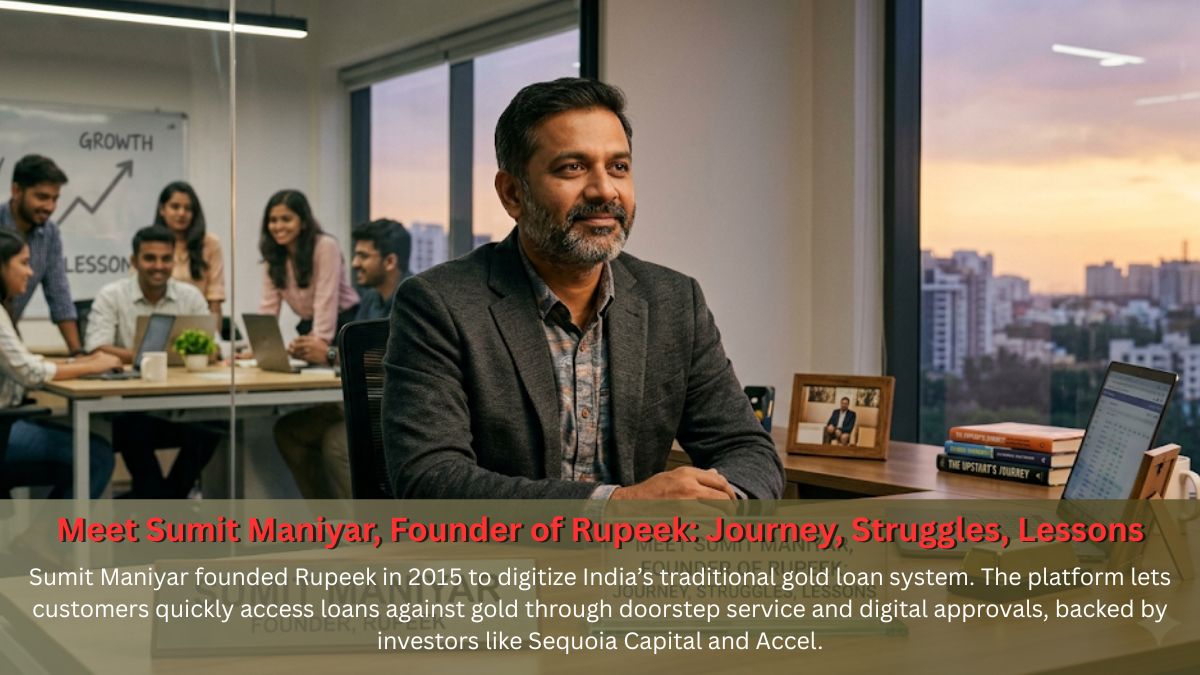
The story of Sumit Maniyar founder of Rupeek is closely tied to India’s evolving fintech landscape and the transformation of a centuries-old financial product: gold loans. In a country where gold has long served as both cultural wealth and emergency liquidity, Maniyar saw an opportunity to digitize a process that had remained largely traditional and opaque. Sumit Maniyar is the founder and CEO of Rupeek, a digital gold loan platform that enables customers to unlock liquidity from their gold assets quickly and securely. Founded in 2015 and headquartered in Bengaluru, Rupeek set out to modernize India’s gold-backed lending ecosystem by combining technology, logistics, and partnerships with financial institutions.
Maniyar’s entrepreneurial journey did not begin with fintech. Before starting Rupeek, he built and sold a mobile advertising startup, gaining experience in scaling technology businesses and understanding consumer behavior in emerging markets. However, while working in the startup ecosystem, he noticed a deeper structural issue in India’s credit market: millions of households owned gold but struggled to access formal credit quickly.
The idea behind Rupeek emerged from this insight. Traditional gold loans required physical visits to lenders, paperwork, and lengthy processes. Maniyar believed technology could simplify this experience through a doorstep service model, secure logistics, and digital loan approvals. Since its launch, Rupeek has attracted significant investor interest and has raised hundreds of millions of dollars from venture capital firms including Sequoia Capital, Accel, and Bertelsmann India Investments. The company has emerged as one of India’s most prominent gold loan fintech startups, building a secured lending platform that works with banks and NBFCs. This founder story explores Sumit Maniyar’s entrepreneurial journey, the struggles he faced building Rupeek, the lessons learned while scaling a fintech company in India, and the long-term vision that continues to shape the startup.
2. Background and Early Life
2.1 Early Life and Education
Sumit Maniyar grew up in India during a period when technology entrepreneurship was still emerging as a career path. Like many founders who later built startups in the digital economy, his early years were shaped by curiosity about technology and problem solving. He pursued higher education at the prestigious Indian Institute of Technology Bombay, one of India’s leading engineering institutions. His academic experience exposed him to rigorous technical thinking, product development principles, and the growing intersection between engineering and entrepreneurship. At IIT Bombay, Maniyar developed an analytical mindset that later helped him navigate complex industries such as finance and digital services.
2.2 Early Career Influences
Before becoming known for building a digital gold loan platform, Maniyar gained experience in the startup ecosystem through his earlier venture. He founded a mobile advertising company called Flyte. The startup focused on helping brands reach consumers through mobile platforms at a time when smartphone adoption in India was accelerating. Flyte was eventually acquired by Komli Media. The acquisition provided Maniyar with valuable experience in building and exiting a startup. This first entrepreneurial journey exposed him to the realities of venture funding, product-market fit, and scaling technology companies. It also gave him confidence to pursue a more ambitious idea later.
3. Founder and Company Overview
3.1 Sumit Maniyar Founder of Rupeek
The Sumit Maniyar founder story is fundamentally about identifying inefficiencies in traditional industries and applying technology to solve them. After his first startup exit, Maniyar began exploring sectors where technology adoption was still low but demand was high. Finance quickly stood out. India’s credit market presented a paradox. Millions of people owned valuable assets like gold, yet access to quick credit remained limited. This insight became the foundation for Rupeek.
3.2 About Rupeek
Rupeek was launched in 2015 as a gold loan fintech startup designed to digitize and simplify gold-backed lending. The platform connects borrowers who want to pledge their gold with financial institutions that provide loans. Rupeek handles the logistics, security, and digital interface that make the process seamless. Instead of visiting a bank branch, customers can request a loan through the Rupeek app or website. The company sends trained agents to collect the gold securely, evaluates it, and facilitates a loan from partner lenders.
3.3 Target Market and Customers
Rupeek primarily serves Indian households that own gold jewelry but need short-term liquidity.
This includes:
- Small business owners
- Self-employed professionals
- Middle-income households
- Rural and semi-urban borrowers
These segments often require quick access to credit but may face hurdles with traditional banking systems. By offering doorstep service and fast processing, Rupeek addresses this gap.
4. The Problem, Insight, and Trigger
India’s relationship with gold runs deep. For generations, families have bought gold not just as jewelry but as security. It is a store of value that quietly sits in lockers and cupboards across the country. In fact, India is believed to hold one of the largest private reserves of gold in the world, with households collectively owning thousands of tonnes. Yet the strange reality is that most of this wealth remains untouched.
When families face financial stress, medical emergencies, business needs, or temporary cash shortages, gold could easily solve the problem. But the process of unlocking that value has traditionally been frustrating and uncomfortable. A typical gold loan experience in India involves visiting a branch of a lender such as Muthoot Finance or Manappuram Finance. Customers often have to travel, sometimes long distances, carrying valuable jewelry. Once they reach the branch, the process begins: waiting in line, filling forms, getting the gold evaluated, negotiating the loan amount, and completing paperwork. For many people, especially in smaller towns, the process feels intimidating.
There is also an emotional layer to it. Gold jewelry in India is rarely just metal. It carries memories. Wedding necklaces, family heirlooms, gifts from parents. Handing these pieces over to a financial institution can feel deeply uncomfortable. The result is predictable. Millions of families choose not to access formal gold loans at all. Instead, they turn to informal lenders, neighborhood moneylenders, or friends. These alternatives often come with higher interest rates and little transparency. This was the gap that eventually caught the attention of Sumit Maniyar, the founder of Rupeek.
4.1 Maniyar’s Key Insight
Maniyar did not initially look at gold loans as a purely financial product. Instead, he looked at the experience surrounding it. And what he saw was a broken system. The more he studied the market, the more he realized something important: the problem was not that gold loans were unpopular. In fact, the demand was enormous. What discouraged people was the process. Borrowers didn’t want complicated paperwork. They didn’t want to travel with valuable jewelry. They didn’t want long waiting times or uncomfortable branch visits. In other words, the biggest barriers were logistics, convenience, and trust.
That realization changed everything. Maniyar began asking a simple question: What if the gold loan came to the customer instead of the customer going to the lender? This idea became the foundation of Rupeek’s doorstep gold loan model. Instead of forcing customers to visit branches, Rupeek created a system where trained executives would visit customers’ homes, evaluate the jewellery on the spot, and facilitate the loan digitally. The gold would then be securely transported and stored in partner bank vaults.
What sounds simple today required a huge rethink of operations. Maniyar had to build a model that combined fintech, logistics, security, and banking partnerships. But the insight was powerful: remove friction from the process, and customers will adopt gold loans more comfortably. That insight eventually shaped Rupeek into one of India’s fastest-growing gold loan platforms.
5. Early Days and Initial Struggles
Like most startup stories, the early days were far from glamorous. The biggest obstacle was not technology. It was trust. Convincing someone to try a new app is easy. Convincing someone to hand over their gold jewelry to a startup they’ve never heard of is a completely different challenge. Every conversation with early customers revealed the same hesitation.
People would ask:
- Who are you?
- What happens to my jewelry after I give it to you?
- What if something goes wrong?
- How do I know it will be safe?
These concerns were not irrational. Gold is one of the most valuable and emotionally significant assets in Indian households. One mistake could destroy the company’s reputation overnight. So Rupeek took trust-building extremely seriously. The company invested heavily in security infrastructure and processes long before it had large revenues. Executives were trained rigorously. The gold transportation process was insured. Secure tamper-proof packaging was used. GPS tracking systems were implemented for logistics. Clear documentation and transparency were built into the customer journey. But even with these precautions, winning trust took time.
Early customers often signed up cautiously. Some asked dozens of questions before agreeing to try the service. Others would start with small amounts of gold before committing larger pieces. Those early adopters became crucial. When their experience turned out to be smooth and reliable, word began spreading through families, friends, and neighborhoods. In India, trust spreads fastest through word-of-mouth. The second challenge came from regulation.
Unlike many fintech startups that operate purely as technology platforms, Rupeek was deeply connected to the lending ecosystem. Gold loans require strict compliance with financial regulations. That meant working closely with banks and NBFCs to structure lending partnerships. Building those partnerships was not easy for a young startup. Large financial institutions move slowly. They require due diligence, risk assessments, and compliance checks. Convincing them to work with a new digital platform required persistence and credibility. But once those partnerships began forming, the business model started gaining stability.
6. Failures, Setbacks, and Self Doubt
Every startup goes through moments where the founder quietly wonders if the idea will ever work. Rupeek had its share of those moments. The company’s model depended heavily on logistics. Unlike a purely digital fintech app, Rupeek had to coordinate real-world operations across cities: executives visiting homes, jewelry evaluation, secure transport, vault storage, and coordination with lenders. Scaling this system was incredibly complex.
Each city required trained teams, secure processes, and tight coordination. One operational mistake could result in delays, customer dissatisfaction, or worse, security concerns. There were days when the operational challenges seemed overwhelming. Could this model really scale nationwide? Could logistics remain secure while expanding rapidly? Customers trust a digital platform with their family gold?
These questions were not theoretical. Investors asked them. Industry observers asked them. And sometimes, the team asked them too.But something interesting started happening as more customers used the platform. The skepticism began fading. Customers who experienced the service often came back again. Many referred friends and family. Repeat borrowing increased. Word-of-mouth grew stronger. Slowly, the early doubts started being replaced by confidence. The market itself was validating the idea.
7. Validation and Early Traction
The real turning point for Rupeek came when the platform began facilitating gold loans at meaningful scale. Customers quickly realized the convenience of the model. Instead of traveling to a branch and waiting hours, they could schedule a doorstep visit. Jewelry evaluation happened in minutes. Loan approval and disbursement were significantly faster than traditional systems. For people running small businesses or facing urgent financial needs, this speed made a huge difference.
Customer feedback consistently highlighted three things:
- Convenience
- Speed of loan approval
- Transparency in the process
Banks and NBFCs also started noticing the benefits.
For lenders, customer acquisition in the gold loan segment traditionally required building expensive branch networks. Rupeek offered them a new channel: a technology-driven platform that could bring customers directly to them. In many ways, Rupeek became both a logistics platform and a distribution partner for lenders. This dual value proposition strengthened the company’s position in the ecosystem. As transaction volumes increased, so did investor interest.
8. Funding, Money, and Growth Constraints
Growth in fintech requires significant capital. Technology development, compliance infrastructure, logistics networks, and customer acquisition all demand large investments. As Rupeek demonstrated traction, venture capital firms began paying attention.
The startup raised funding from several well-known investors including:
- Sequoia Capital
- Accel
- Bertelsmann India Investments
This funding played a critical role in Rupeek’s next phase.
First, it allowed the company to strengthen its technology infrastructure. The platform had to handle loan processing, customer verification, logistics tracking, and lender integration seamlessly. Second, it helped Rupeek expand geographically. Entering new cities required operational teams, secure storage partnerships, and regulatory compliance. Capital made this expansion possible. Third, funding allowed the company to invest deeply in security and risk management systems, which were essential in a business involving physical gold.
But growth also brought new pressures. As operations scaled, maintaining consistent service quality became more challenging. Logistics complexity increased. Customer expectations rose. Yet these challenges were also signs that the idea was working. What started as a bold insight about fixing the gold loan experience had grown into a rapidly expanding fintech platform. And for millions of Indian households sitting on idle gold, Rupeek was slowly turning that sleeping wealth into accessible financial liquidity.l capabilities.
9. Team Building and Leadership Evolution
In the early days of Rupeek, the team was small enough for everyone to sit in the same room. Decisions happened quickly. Problems were solved on the fly. And like most startups, everyone did a little bit of everything. But as the company began to grow, things changed. Growth brings excitement, but it also brings complexity. What worked for a ten-person startup simply does not work for a company operating across multiple cities and handling thousands of loans. Systems need structure. Teams need leadership. Responsibilities must be clearly defined. This was one of the biggest transitions for Sumit Maniyar. He had to move from being a founder who solved problems personally to a leader who built systems and empowered others to solve them.
The company began hiring specialists across key areas:
- Technology teams to build secure fintech infrastructure
- Operations teams to manage doorstep gold collection and logistics
- Risk and compliance teams to ensure financial and regulatory stability
- Customer support teams to maintain trust and service quality
Each of these functions became critical as Rupeek expanded.
One of Maniyar’s biggest leadership lessons during this phase was the power of delegation. In the early days, founders often feel the need to control everything. But scaling a company requires letting go of that instinct. He began focusing more on hiring leaders who were better than him in specific domains. Engineers who understood fintech architecture better. Operations experts who could design secure logistics networks. Risk professionals who understood lending frameworks inside out.
Building that leadership layer allowed Rupeek to grow from a promising startup into a structured organization capable of operating at scale. But this evolution was not just operational. It was personal too. Learning to trust others with decisions, mistakes, and accountability is one of the most difficult transitions any founder faces. And yet it is also the transition that allows a company to grow beyond its founder.
10. Growth, Scaling, and Operational Challenges
Scaling a fintech company is never easy. But scaling a fintech company that deals with physical gold adds another layer of complexity. Every loan facilitated through Rupeek involves a chain of operations that must work perfectly.
The company has to manage:
- Secure gold collection from customers’ homes
- Transport logistics with strict security protocols
- Vault storage through partner banks and institutions
- Loan disbursement and repayment processes
- Risk assessment and fraud prevention
- Customer support across multiple cities
If even one part of this chain breaks down, the entire customer experience suffers. For example, delays in gold transportation could slow down loan approvals. Weak risk systems could increase defaults. Poor customer communication could destroy trust. So as loan volumes increased, operational efficiency became one of Rupeek’s biggest priorities. The company invested heavily in automation and analytics to reduce friction across the system. Technology platforms were built to track every step of the gold loan journey. From customer onboarding to logistics tracking to loan repayment schedules, everything had to be tightly integrated.
Data also started playing a major role. Analytics helped the team identify patterns in borrower behavior, optimize loan processing times, and improve risk evaluation models. Over time, this data-driven approach allowed Rupeek to scale operations while maintaining consistency. But even with technology, operations remained a daily challenge. Running a platform that handles physical assets across multiple cities requires discipline, constant monitoring, and relentless attention to detail. It is not glamorous work, but it is the kind of work that determines whether a company survives long term.
11. Personal Sacrifices and Burnout
Behind every startup success story lies a quieter reality that people rarely talk about: the personal cost. Building a company is not just intellectually demanding. It is emotionally exhausting. For founders like Sumit Maniyar, the early years of building Rupeek were filled with long working days, difficult decisions, and constant uncertainty. There were moments when the pressure felt overwhelming.
Investors expected growth. Customers expected flawless service. Partners expected reliability. Employees expected leadership and direction. And in a business involving financial services and valuable assets like gold, the stakes were even higher. Mistakes were not just inconvenient. They could be catastrophic. Founders often carry this pressure silently. While the outside world celebrates funding announcements and expansion news, the internal reality can look very different. Late nights reviewing operations reports. Endless calls with partners and investors. Travel across cities to fix operational issues.
There were periods when exhaustion and burnout were real risks. Like many entrepreneurs, Maniyar had to learn how to manage that pressure without letting it consume him. That meant building stronger teams, trusting leadership around him, and slowly shifting his role from day-to-day firefighting to strategic direction. Startup journeys are often portrayed as heroic. In reality, they are messy, emotional, and full of moments where founders question whether they can keep going. What keeps them moving forward is usually not hype. It is belief in the problem they are solving.
12. Lessons, Beliefs, and Values
Over time, the journey of building Rupeek revealed several important lessons. The first and perhaps most powerful lesson was this: real businesses solve real problems. Many startups chase trends. They build products because an industry looks exciting or because investors are interested in it. But those businesses often struggle when the initial excitement fades. Rupeek succeeded because it focused on a deeply rooted problem in the Indian financial ecosystem.
Millions of households owned gold. Millions of those households also needed access to credit. But the process of turning gold into liquidity was inconvenient and intimidating. By fixing that experience, the company created genuine value. Another critical lesson was the importance of trust.
Financial services operate entirely on trust. Customers must trust that their money, their assets, and their data are safe. Partners must trust that operations are reliable. Investors must trust that the business is sustainable. Trust is not built through marketing. It is built through consistent behavior over time. Every secure transaction, every transparent communication, every positive customer experience slowly compounds into credibility. For Rupeek, protecting customer trust became one of the most important internal values.
13. Present Challenges and Future Vision
Today, Rupeek operates as one of India’s leading digital gold loan platforms. The company has helped modernize a financial product that has existed for centuries but had remained largely unchanged. Yet the journey is far from over. India still has enormous untapped potential in gold-backed lending. A significant portion of household gold remains idle. Unlocking that value could improve access to credit for millions of families and small businesses. Looking ahead, Rupeek’s vision involves several directions.
First, deeper integration with banks and financial institutions could expand the availability of gold-backed credit across the country. Second, continued investment in technology infrastructure will help improve efficiency, security, and loan processing speed. Third, the company may expand into adjacent fintech services, building a broader ecosystem around secured lending. But beyond products and expansion plans, the mission remains simple and clear.
For Sumit Maniyar, the goal has always been to modernize a traditional financial service and make it more accessible to everyday people. Gold has always been a symbol of wealth in India. Rupeek’s ambition is to ensure that this wealth does not just sit quietly in lockers but becomes a practical financial tool that helps people when they need it most.
Future Outlook
The Sumit Maniyar founder journey illustrates how traditional industries can be transformed through technology. Rupeek’s approach to gold-backed lending shows the potential of combining logistics innovation, fintech infrastructure, and customer-centric design. As India’s fintech ecosystem continues evolving, companies like Rupeek highlight how startups can unlock value from existing assets rather than creating entirely new financial products.
The future of the gold loan fintech startup ecosystem will likely involve greater digital adoption, stronger regulatory frameworks, and deeper partnerships between fintech companies and traditional lenders. For Sumit Maniyar founder, the challenge ahead is not just scaling Rupeek but redefining how millions of Indians access credit using assets they already own.
About foundlanes.com
foundlanes.com is India’s leading startup idea discovery platform. It helps entrepreneurs find actionable startup opportunities, market insights, and industry-specific guidance to turn ideas into real businesses. With deep research and practical resources, foundlanes supports founders at every stage, from idea validation to launch and growth.